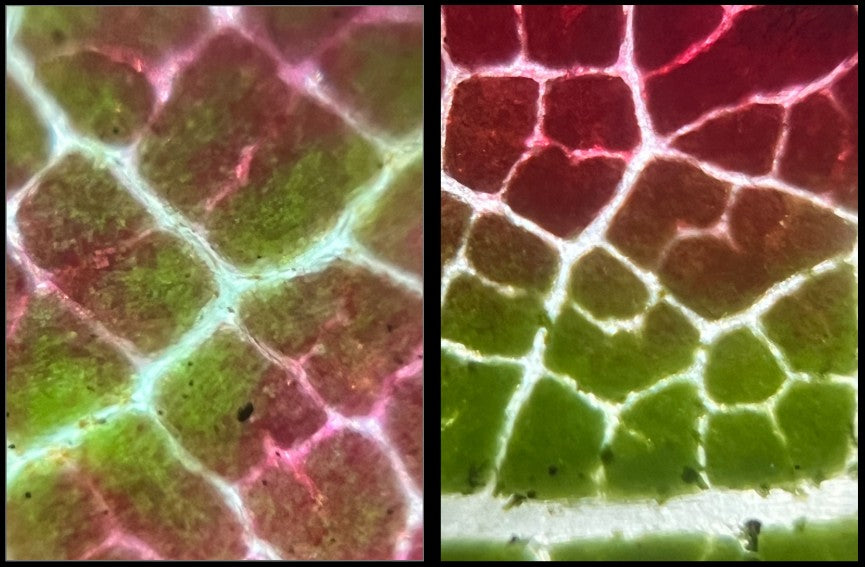

Hello Foldscope family, and welcome to the “Foldscope In The Classroom: In The Garden” year end reflection. This blog is different from past Foldscope In The Classroom blogs. Rather than describing a specific activity, I am reflecting on my yearlong Foldscope-based garden study. I hope it encourages you to slow down, reflect, and plan your 2026 microscopy explorations.
First, I want to say that I can’t believe an entire year has gone by since I began my microscopic garden journey! Thank you for joining me on this crazy ride! Giving your students access to a tool like a Foldscope lets them experience authentic scientific inquiry. You don’t always know what you are going to see. Every drop of water, soil particle, or leaf is a mystery waiting to be observed and understood. This joy of discovery makes learning fun, just like science is supposed to be!
Outdoor Research:
Nothing brings science to life quite like a garden. The close observation of patterns, seasonal relationships, soil transformations, plant growth cycles, and decomposition makes science less conceptual and more tangible. Incorporating Foldscopes into your scientific garden study reveals the intricate and hidden beauty of this dynamic ecosystem on a cellular level.
Focusing on one specific part of the garden each month gives students a big picture view of what happens throughout the year. The cycle of soil, seed, root, plant, leaves, flower, fruit, and the return to the soil, is a great way to introduce the concepts of timelines, sequencing, and storytelling into the science lesson. And, when every student has their own Foldscope, each story they discover can be unique within the common theme of life cycles.
The key to this immersive hands-on experience is the fact that it takes place outside. The outdoors is a great place to use a Foldscope. They are affordable, durable, waterproof, and incredibly easy to use! Your students can investigate samples with confidence and you can relax because there is no expensive equipment to worry about. With a Foldscope, students transform into scientists as they collect samples, prepare slides, identify microscopic structures, and analyze their observations. Think about how empowering it is for a student to say that they found a new microorganism, observed microscopic interactions no one had seen before, or that they simply experienced the wonder of the microscopic world for the first time. For some students, this could be what sparks their curiosity and interest in science!
Reflecting on the Scientific Process:
It is important to remember that when doing research, scientists don’t have all of the answers when they begin. Oftentimes, they don’t even know the questions until they collect data, look for patterns, and analyze the results. It is what you will be doing with your students when you hand them a Foldscope. While you may have a general idea of what you and your students will see with your Foldscope, the natural world is full of microscopic wonders that haven’t been discovered yet.
Your guiding questions and answers become clear when you slow down, closely observe each part of the ecosystem, and reflect on what you are seeing. Using all of your senses to explore the garden makes reflection easier because you are taking in more than just visual cues from the environment. A student may touch two different soil samples, study them under their Foldscope, and ask themselves, “If I were a plant root, which one would I prefer to grow in?” With time for reflection, they can formulate an answer backed by microscopic and sensory evidence.
As a science teacher, reflection can help you navigate your way through the garden each month. Reflection can also help you modify your lessons for next year or plan vertically aligned lessons with the teachers above and below your grade level. This can lead to a deeper understanding of the science concepts you teach your students. The affordability of Foldscopes makes them a great tool for both horizontal and vertical lesson alignments because every student in every classroom can have access to one.
What Is Next?
I enjoyed this year of Foldscope microscopy in the garden. Intentionally slowing down and observing the patterns and cycles of life gave me a deeper appreciation for the tiny invisible microbes and structures that influence and impact what we see on the macroscopic level. After reflecting on my outdoor research, I have a lot of ideas in store for next year that I’m sure will lead to fun and surprising discoveries that I can’t wait to share with the Foldscope community!
Connect:
However you chose to join my microscopic garden journey of 2025, I would love to hear your thoughts. Did you do the activities with me each month? What fresh ideas are sprouting up in your mind for next year? Did you follow along so that you could plan a similar study in the future? How are you going to roll out your longitudinal Foldscope garden study? You can email your reflections to me at holly@foldscope.com.
As always, I hope you take the time to share your observations, discoveries, and pictures of any sample with the Foldscope community on the Microcosmos. Your contributions will build up a strong scientific database that can help support new and innovative scientific research. Tag us on social media, too. We love to see how Foldscopers around the world are using their Foldscopes in new and innovative ways!
Facebook: @Foldscope
Instagram: @teamfoldscope
Blue Sky: @teamfoldscope.bsky.social
TikTok: @foldscope
Threads: @teamfoldscope
Twitter: @TeamFoldscope